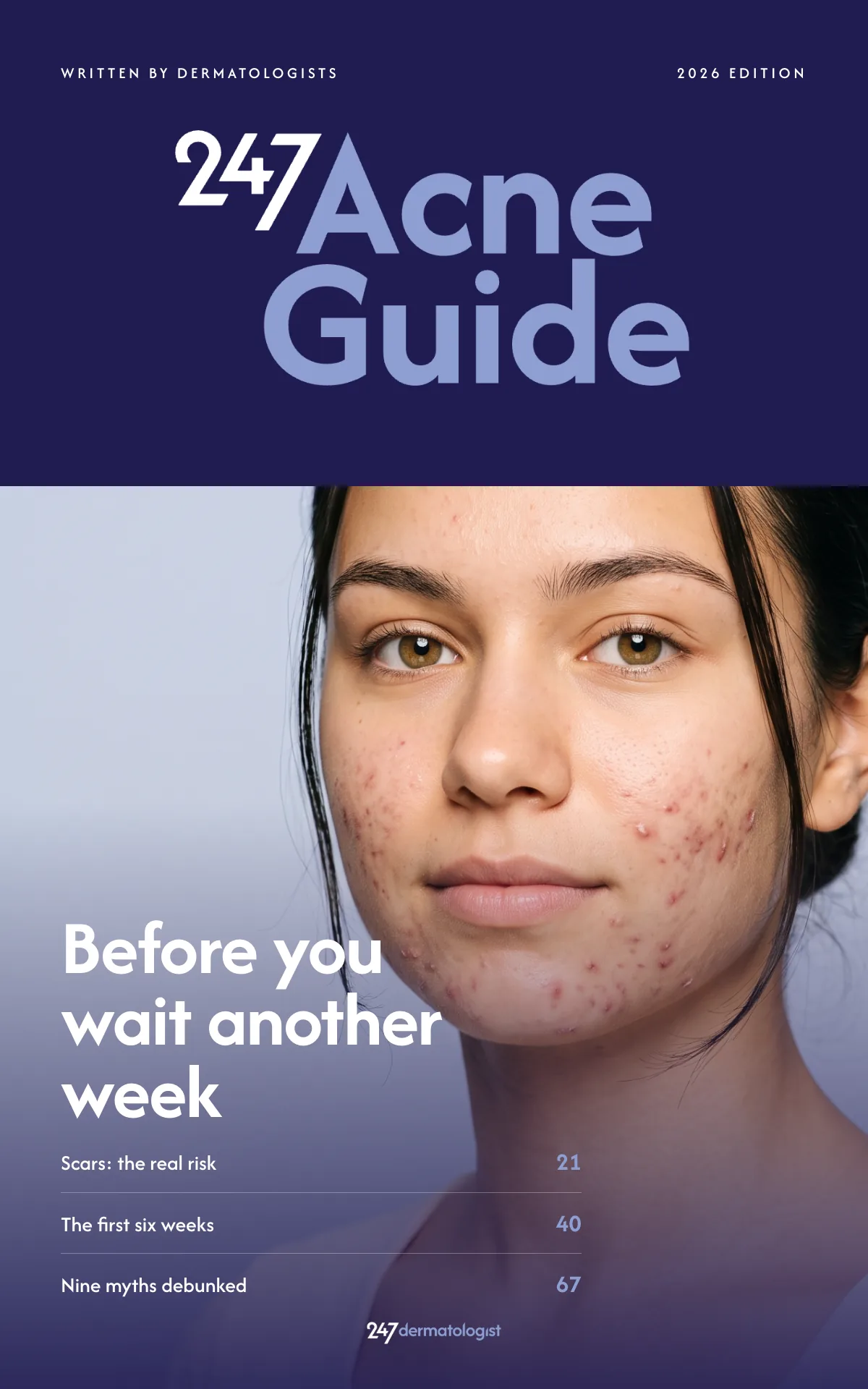
AT A GLANCE
Five things to remember
The rest of this guide explains why. Here are the key points.
01
It is not your fault
Acne develops in the sebaceous gland, beneath the surface of the skin. It is not caused by poor cleansing or by eating the wrong foods.
02
The duration of inflammation matters
It is not the severity but the duration of the inflammation that is associated with scarring. Waiting is therefore not a neutral choice.
03
The type determines the treatment
Blackheads and whiteheads require a different approach from deep, painful lumps. Finding out what you have comes before treating it.
04
The first six weeks are the hardest
Your skin may react before it improves. That is normal. Build up slowly, moisturise and take photos.
05
Clear skin does not mean you are finished
Even when your skin has settled, microcomedones may still be present. Maintenance treatment helps prevent the next flare-up.
CHAPTER 01
Foreword
Acne can be treated. Preferably starting today.
IN THIS CHAPTER
- Why this guide exists
- What it does and does not cover
- How 247dermatologist works
Acne can be treated. Preferably starting today.
Acne is one of the most common skin conditions, yet its impact is still often underestimated, including by people who live with it daily.
We published the first edition of this guide last year. Since then, the European acne treatment guideline has been revised. One insight from that update is so important that it forms the basis of this new edition: the duration of inflammation is associated with the risk of scarring.
The time between your first spots and the start of the right treatment therefore matters, not only for how your skin looks in a few months, but also for what may still be visible years later.
That is why we have rewritten this guide. Shorter, so you can actually finish it. More precise, with a source behind every figure. And more practical, with new chapters on the first six weeks of treatment, on maintenance once your skin is clear, and on the questions parents often have.
What you will not find here is a miracle cure. There is no such thing. What you will find is what we know, what works, and why timing matters so much.
The time between your first spots and your first treatment is not simply waiting time. It is time during which the inflammation continues.
Dr Marco van Coevorden, Dermatologist, Medical Director and Co-founder of 247dermatologist.
CHAPTER 02
What acne is and how it develops
Where acne begins, and why washing harder does not help.
IN THIS CHAPTER
- The sebaceous gland and the microcomedo
- From comedone to inflammation
- Why the skin produces too much sebum
First things first: it is not your fault
Acne is not caused by dirty skin. It is not a punishment for what you eat, and it is not a sign that you are failing to look after yourself. Acne develops deep within the skin, in a place that washing cannot reach.
It is not contagious either. Although inflammation is involved, acne is not an infectious disease.
Where it begins: the sebaceous gland
Your skin contains sebaceous glands. They produce sebum, an oily substance that helps protect your skin from drying out and from external influences. Sebum normally drains out through your pores.
In acne, this process becomes disrupted. Sebum production increases while dead skin cells are not shed effectively enough. Material builds up inside the pore and the sebaceous follicle becomes blocked.
From blockage to comedone
If the blockage grows, it becomes a comedone: a blackhead or a whitehead. There are two types.
WHITEHEAD
Closed comedone
The pore is completely closed. The build-up remains underneath and stays white.
BLACKHEAD
Open comedone
The pore is open. The sebum comes into contact with oxygen, oxidises and turns black. The dark colour is not dirt.
From comedone to inflammation
A blocked pore does not necessarily cause a problem by itself. Inside that enclosed space, however, bacteria, particularly Cutibacterium acnes, have an opportunity to multiply. This can trigger an inflammatory response.
If the blocked follicle ruptures, its contents spill into the surrounding tissue. Your immune system responds, producing the redness, swelling and inflamed spots you can see.
Papules
Red, swollen bumps without pus.
Pustules
Inflamed spots with a white or yellow head.
Nodules and cysts
Deep, painful areas of inflammation beneath the skin that can persist for a long time.
Four stages, on the same scale: from healthy pore to inflammation
Stage 1
Healthy pore: sebum drains normally.
Stage 2
Microcomedo: a blockage beneath the surface, not yet visible.
Stage 3
Comedone: an open and a closed comedone side by side.
Stage 4
Inflammation: the follicle ruptures and the surrounding tissue reacts.
Why does the skin produce too much sebum?
Usually, more than one factor is involved.
- Hormonal fluctuations, the main driver. Androgens such as testosterone stimulate the sebaceous glands.
- Genetic predisposition. Acne in the family raises your own risk.
- Stress. This raises cortisol, which can also increase sebum production.
- Certain skincare and make-up products. Some formulations can block the pores.
This helps explain why acne often flares during puberty, around a period, during pregnancy, or after stopping the pill.
CHAPTER 03
The different types of acne, and conditions that can look like it
The type determines the treatment. The five presentations we see most often, plus two conditions that resemble acne but are not acne.
IN THIS CHAPTER
- The five most common presentations
- What looks like acne but is not
- Telling rosacea and yeast spots apart
Not all acne is the same
That is not a minor detail. The type of acne determines the treatment. Someone with blackheads and whiteheads alone needs something very different from someone with deep, painful lumps. Good treatment therefore always starts by establishing exactly what you are dealing with.
Acne vulgaris is the most common form and the umbrella term for acne caused by blocked sebaceous glands. Do not be misled by the name: vulgaris simply means common.
The five presentations we see most often
1. Comedonal acne
Mainly blackheads and whiteheads, with little inflammation. The skin feels uneven, but there are few or no red spots. That does not make it any less frustrating, and it still requires a targeted approach.
2. Hormonal acne
Hormonal fluctuations are the main driver of acne. This presentation is common among teenagers during puberty, women around their periods, during pregnancy or the menopause, and people with hormonal conditions such as PCOS. It usually affects the jawline, chin and cheeks.
3. Inflammatory acne
Red, swollen spots and pustules with a white or yellow head. They may feel painful and the surrounding skin is red. This is the presentation for which early treatment makes the greatest difference.
4. Cystic acne
A severe form in which inflammation sits deep within the skin. Instead of superficial spots, large, red, painful lumps develop and may contain pus. The swelling is more pronounced, the risk of scarring is higher, and the lumps can hurt even when you are not touching them.
5. Acne conglobata
A rare and extreme form in which areas of inflammation merge into large abscesses and deep inflammation beneath the skin. This always requires intensive care from a dermatologist.
Acne is often described as though it only affects the face. That is not true. After the face, the back, chest and shoulders are the most commonly affected areas, and around half of people with facial acne also have it on the trunk. You can read how it is treated in Chapter 7.
Acne looks different on every skin tone
On fair skin, inflammation can look bright red or pink. On dark skin, the redness can look more subtle, and dark marks after inflammation can stand out more. The appearance also varies according to the type of acne: from blackheads and whiteheads with barely any redness to pustules and deep, painful lumps.
Treatment therefore begins by establishing exactly what you have.
What looks like acne but is not
Two conditions are regularly mistaken for acne. This matters because acne treatment can make them worse.
Rosacea
A chronic skin condition involving inflamed bumps, redness and irritation. Unlike acne, it is not caused by blocked sebaceous glands. It mainly affects the cheeks, nose and chin, which can make you look as though you are constantly blushing. Standard acne products can aggravate rosacea.
Yeast-related folliculitis, also known as Pityrosporum folliculitis
This is caused by an overgrowth of yeast in the hair follicles. The bumps are usually all roughly the same size, they are very itchy, and they appear in clusters. It is not caused by oily skin or blocked pores, but by an imbalance in the skin's microorganisms. It therefore needs a different treatment.
READ MORE
CHAPTER 04
Why early treatment makes all the difference
95%
of patients seen for acne at a dermatology practice show some degree of scarring.
Source: EuroGuiDerm guideline for the treatment of acne, 2025 update.
One sentence from the guideline
One sentence in the new European guideline changes how we should think about acne: the duration of inflammation is associated with scarring. Read that again. Not the severity. The duration.
That means the weeks between your first spots and your first treatment are not simply waiting time. They are time during which the inflammation continues. And the longer it continues, the greater the chance that it will leave something behind.
The size of that risk surprises most people. The guideline states that scarring has been identified in up to 95 per cent of patients seen for acne in dermatology practices. That is not the exception. It is the norm.
What happens while you wait
A blocked pore is not yet a problem. But within that enclosed space, bacteria have an opportunity to multiply, triggering an inflammatory response. If the follicle ruptures, its contents enter the surrounding tissue and your immune system reacts. That produces the redness and swelling you can see.
What you cannot see is what happens underneath. Deep or prolonged inflammation damages the tissue below. If the tissue repairs itself too little, a depression forms. If it repairs itself too much, a raised scar develops. In both cases, a scar remains, and scars do not disappear by themselves.
It is not the severity of your acne that determines the risk of scarring, but how long the inflammation continues.
Early treatment does not mean aggressive treatment
Treating early does not mean starting with the strongest medication straight away. It means identifying the type of acne early and matching the treatment to it. Mild comedonal acne needs something very different from deep, painful inflammation.
This is exactly why trial and error so often goes wrong. Not because the products are necessarily poor, but because you are treating on the basis of guesswork while time passes.
What this means for you
- Have you only recently developed spots, mainly blackheads and whiteheads? You have time to start gently, but do not wait for it to become worse.
- Do you have deep, painful lumps that stay for a long time? Acting quickly is the most important thing you can do now.
- Can you already see dark marks or depressions where spots used to be? Damage has already occurred, so treatment is then about preventing further damage too, not only about clearing your skin.
Your skin cannot wait. Not because we say so, but because the inflammation does not wait.
CHAPTER 05
Scars and pigmentation marks
What remains after a spot is not always a scar. It is usually a change in colour. The difference determines what can be done about it.
IN THIS CHAPTER
- The difference between pigmentation and a scar
- What does and does not help with pigmentation
- When a scar can be treated
First, the difference: pigmentation or a scar?
What remains after a spot can stay visible for a long time. That is not always a scar. It is often a change in colour. The distinction matters, because the treatment is not the same.
PIGMENTATION
Flat and smooth
As inflammation heals, the skin may produce more pigment there, leaving a dark, flat mark: post-inflammatory hyperpigmentation. Run a finger over it and you will feel no depression or bump, only a change in colour.
ON FAIR SKIN
Red or purplish
On fair skin, a red or purplish mark is more common: post-inflammatory erythema. It is not pigment but dilated blood vessels, and it too tends to fade on its own.
The good news: pigment fades. The less good news: it can take months, sometimes over a year, and sunlight makes marks darker and more persistent.
Scars after acne
In a scar, tissue has been damaged. You can feel the difference: the skin is no longer smooth.
Atrophic scars, depressions
The tissue has not fully repaired. This is the most common type of acne scar.
Hypertrophic scars, raised areas
The body has produced too much tissue. This is more common on the back, chest and shoulders.
Scars do not fade by themselves. They can be treated, but treatment is a process, not a single cream.
What happens beneath the skin
With a pigmentation change, the skin’s structure stays intact and the colour change sits in the upper layers. With an atrophic scar, tissue has been lost beneath the surface of the skin.
CROSS-SECTION 1
Pigmentation change
The skin is smooth, pigment sits in the upper layers.
CROSS-SECTION 2
Atrophic scar
Tissue has been lost beneath the surface of the skin.
You can feel the difference: pigmentation leaves the skin smooth, whereas a scar changes the skin’s texture.
Skin type matters
In darker skin, skin types IV to VI, pigmentation changes are often the main reason people seek help, more than the spots themselves. Darker skin naturally produces more pigment, so inflammation more easily leaves a dark mark that lasts longer.
This calls for two things: keeping inflammation as brief as possible, since every extra week gives pigment more time to form, and using sun protection consistently, since sunlight helps pigment persist. SPF 30 or higher is not excessive for darker skin, even if you rarely burn.
We factor this into treatment choice. Products that cause significant skin irritation can trigger more pigmentation in darker skin. That is not a reason to avoid treatment, but a reason to choose the right one.
How to prevent scarring
Treat early
The shorter the inflammation lasts, the lower the risk of damage. That is the central message of Chapter 4.
Do not squeeze
Squeezing pushes inflammation deeper into the skin and increases the very risk you want to avoid. There is more on this in Chapter 14.
Protect your skin from the sun
Sunlight darkens pigmentation marks and makes them last longer.
Treating the acne itself is the best way to prevent scars. No cream can prevent damage from inflammation that continues for months.
How scars and pigmentation are treated
For pigmentation
Targeted creams, consistent sun protection and sometimes a superficial peel. Patience is part of the process: this takes months.
Chemical peels
Acids accelerate the shedding of the upper layers of skin. This can fade superficial scars, fine lines and pigmentation marks. Several sessions are usually needed.
Laser treatment
A fractional CO2 laser makes microscopic channels in the skin. This stimulates collagen production, helping the skin become firmer and more even. It is particularly suitable for deeper or indented scars. Again, several sessions are needed, with recovery time between them.
Microneedling
Whether this is suitable depends on the type of scar.
Not every scar requires the same approach. Have your scars assessed before starting treatment.
CHAPTER 06
How acne affects you
Acne does not stay in the mirror. It comes with you to school, work, a first date and a job interview.
73%
of people with acne felt embarrassed about it, according to research among 649 people.
Among 649 people with acne
In research among 649 people with acne, many said the condition’s impact went far beyond appearance.
73%
felt embarrassed about their acne
76%
felt unattractive because of their acne
74%
felt they had missed out on opportunities or promotions at work
74%
felt held back from doing things they wanted to do
Source: Burden survey, combined facial and truncal acne, January 2020. Conducted by Kantar on behalf of Galderma, n=649. We include these figures because they are supported by evidence, and because most people with acne think they are the only person who feels this way.
Acne and dating
Acne can make dating feel even more daunting. Will the other person notice my spots first? Should I mention them, or say nothing?
These thoughts are normal. Research confirms what you may already suspect: we judge ourselves more harshly than others do. Attraction is about far more than skin. Your presence, energy, humour and the way you speak all contribute to the impression you make.
Acne and work
Work and job interviews can already bring tension and self-doubt. Add feeling self-conscious about your skin and it becomes harder to present yourself with confidence.
Frustratingly, stress can aggravate acne. The more pressure you feel to look good, the more likely your skin is to flare. It is an unpleasant cycle, but a breakable one: treat the acne, rather than simply telling yourself to worry less.
Acne and starting a family
Starting a family can raise questions about your skin. Some treatments, including isotretinoin, must not be used during pregnancy or when trying to conceive. Others are safe, or can be adjusted with your doctor. Discuss your treatment in good time if you want to become pregnant.
Some people worry about heredity. Acne does have a genetic component, but hormones, stress and skincare play at least as large a role. It should not make you question your wish to have children.
CHAPTER 07
Treatments for each type of acne
This chapter follows the European guideline revised in 2025. First, it explains the first choice treatment for each type of acne. It then describes what each treatment does.
IN THIS CHAPTER
- First choice by type of acne
- What each treatment does
- What changed in the 2025 guideline
What changed in 2025
Less use of antibiotics
The guideline strongly favours short courses, always combined with a topical treatment, and advises against prolonged use.
A greater role for retinoids
Retinoids are regarded as a foundation treatment. They reduce microcomedones, address the underlying process and help prevent new lesions.
New treatments
The guideline explicitly mentions trifarotene and clascoterone. Clascoterone received European marketing authorisation in October 2025 and had not yet been incorporated into the treatment algorithm when the consensus was reached.
More emphasis on preventing scars
The duration of inflammation plays an important role here.
Which treatment for which presentation?
The tables below are a simplified summary of the guideline recommendations. They are not a menu: the right treatment for you also depends on your skin type, sensitivity, previous treatments and whether you are pregnant or planning a pregnancy.
| Type of acne | First choice according to the guideline | Other options |
|---|---|---|
| Mainly blackheads and whiteheads, comedonal acne | There is no strong consensus on a single first choice. A topical retinoid is recommended. | Benzoyl peroxide, azelaic acid |
| Mild to moderate inflammatory acne | A fixed-dose combination of adapalene with benzoyl peroxide, or benzoyl peroxide with clindamycin. | Topical retinoids, benzoyl peroxide, azelaic acid, a fixed-dose combination of clindamycin with tretinoin, or a systemic antibiotic together with a topical retinoid |
| Severe inflammatory acne to moderate nodular acne | Systemic isotretinoin. | A systemic antibiotic combined with a topical retinoid, with adapalene and benzoyl peroxide, or with azelaic acid |
| Severe nodular acne and acne conglobata | Systemic isotretinoin. | A systemic antibiotic combined with topical treatment |
Source: EuroGuiDerm guideline for the treatment of acne, 2025 update, recommendations by acne type. Simplified for patients. This guide does not use medicine brand names and describes treatments by class.
The treatments, and what they do
Benzoyl peroxide
One of the most commonly used treatments for mild to moderate acne. It has antibacterial and mildly exfoliating effects: it kills acne-related bacteria and loosens dead skin cells, making pores less likely to become blocked. It can temporarily irritate the skin and may bleach clothing and bed linen. Risk of scarring: benzoyl peroxide reduces inflammation and therefore shortens the period during which damage can occur.
Azelaic acid
An alternative that is particularly suitable for sensitive skin. It reduces inflammation and helps prevent blackheads, whiteheads and inflamed spots. It generally causes less irritation than other active ingredients. It can also improve pigmentation marks, making it especially useful for darker skin.
Retinoids
Retinoids are derived from vitamin A. They stimulate skin renewal, reduce the formation of comedones and have an anti-inflammatory effect. The 2025 guideline regards them as a cornerstone of treatment and of the maintenance treatment that follows. Apply them in the evening and always use sun protection during the day, as retinoids make the skin more sensitive to UV radiation. Chapter 8 explains how to start. That chapter is not optional: most people who stop treatment do so during the first few weeks. Important: retinoids must not be used during pregnancy or when trying for a baby.
Topical antibiotics
For moderate to more severe inflammatory acne, topical antibiotics such as clindamycin may be prescribed. They combat inflammation and acne-related bacteria. They are never used as the only treatment, but are always combined with benzoyl peroxide to improve effectiveness and help prevent resistance.
Combination treatments
These contain more than one active ingredient in a single product. Examples include adapalene with benzoyl peroxide, or clindamycin with benzoyl peroxide. They target blocked pores, bacteria and inflammation at the same time, and are easier to use consistently than two separate products. That last point is not a minor detail: following your treatment consistently is one of the strongest predictors of a good result.
When topical treatment is not enough
Oral antibiotics
If topical treatment has not worked well enough after six to eight weeks, or if the acne is moderate to severe and carries a risk of scarring, tablets may be considered. These are usually tetracyclines such as doxycycline or minocycline. They have two effects: they target acne-related bacteria and reduce inflammation. Take the medicine with a full glass of water, preferably while sitting or standing upright, and not immediately before going to bed. Tetracyclines make the skin more sensitive to sunlight, so sun protection is important during the course. Side effects are usually mild and may include minor stomach or bowel problems.
Isotretinoin
Isotretinoin is a powerful oral medicine from the retinoid group. It is used for severe acne with a risk of scarring, and for moderate acne that repeatedly returns despite previous treatments. It works on several fronts at once: it reduces sebum production and inflammation, and inhibits the growth of acne-related bacteria. Most people notice an improvement after six to twelve weeks, and a full course usually lasts eight to ten months. Isotretinoin is the only treatment that can produce a long-lasting or permanent effect. It also requires strict medical supervision. Regular blood tests are carried out to monitor liver function and lipid levels, among other things.
| Typical treatment timeline | What happens |
|---|---|
| 6 to 12 weeks | Most people begin to notice an improvement. |
| 8 to 10 months | The usual duration of a full course. |
| Afterwards | Wait at least six months before starting scar treatment. |
What to look out for during treatment
Your skin becomes drier
Almost all acne treatments do this. Adjusting your skincare is therefore not a luxury. Chapter 10 explains what to use.
Your skin becomes more sensitive to sunlight
Protect it with SPF 30 or higher, even on cloudy days.
Do not combine products without advice
If you take oral retinoids, do not combine them with topical retinoids or other strongly drying products.
Pregnancy and breastfeeding
Retinoids, whether topical or oral, and antibiotics from the tetracycline group must not be used during pregnancy or breastfeeding.
Give it time
A topical treatment needs at least twelve weeks to show what it can do. Do not expect results after a few days. Patience, consistency and good guidance matter more here than the product itself.
Acne does not only affect your face
Around half of people with facial acne also have acne on the back, chest or shoulders. In a survey of 2,000 people aged 14 to 29, the figure was 51 per cent. In an international study, it was 53 per cent.
Yet it is almost never mentioned. Among people who see a doctor about facial acne, 22 per cent do not volunteer that it also affects their trunk. What patients report about facial acne matches what the doctor observes in 92 per cent of cases. For the trunk, the figure is around 70 per cent.
That is not a minor detail. It means a substantial amount of acne that should be treated is not even mentioned.
51%
of 2,000 people aged 14 to 29 in a survey had acne on both the face and trunk
22%
do not volunteer that their trunk is also affected
70%
agreement between what the patient reports and what the doctor finds on the trunk, compared with 92% for the face
Why acne on the trunk is different
The skin on your back and chest is thicker and contains larger sebaceous glands. Inflammation sits deeper and lasts longer. Scars in these areas are also more likely to be raised rather than indented, and raised scars are more difficult to treat.
Clothing, sweat and friction can keep the problem going. The surface area to treat is also much larger than on the face. You need more product, it is harder to apply, and results can take longer to appear. That makes sticking with treatment extra difficult.
How it is treated
The principles are the same as for facial acne: topical treatment is the foundation, with systemic treatment added for extensive or severe acne. Three practical points are different.
One
Not every medicine is licensed for use on the trunk. Ask about this explicitly. This is one of the few areas of acne treatment where the specific medicine you are prescribed genuinely matters.
Two
The 2025 guideline addresses truncal acne for the first time and discusses the effectiveness of newer topical retinoids in this area.
Three
Application requires a practical solution: a mirror, help from someone else, or a formulation that can cover a large area in one go. Discuss this with your dermatologist. If you cannot apply it properly, even the best treatment will not work.
What you can do yourself
- Shower straight after exercise and do not allow sweat to dry on your skin.
- Wear breathable clothing that is not too tight.
- Wash sports clothing at an adequate temperature.
- Do not leave a backpack or shoulder strap rubbing against sweaty skin for hours.
This helps, but it is not enough by itself. Acne on the trunk is just as much a medical condition as acne on the face and deserves the same treatment.
Acne on the trunk is just as much a medical condition as acne on the face.
CHAPTER 08
The first six weeks: what is normal?
Most people do not stop because the treatment is ineffective. They stop because their skin reacts in week two and no one warned them that this could happen.
IN THIS CHAPTER
- What your skin may do
- How long irritation is normal
- When you should contact us
What your skin may do
Topical retinoids can cause irritation. This is usually mild and temporary. The most commonly reported symptoms are redness, dryness, flaking and a burning or stinging sensation.
This does not mean your skin is being destroyed. It means your skin is renewing itself more rapidly. It is expected, it passes, and it is not a reason to stop.
Build up gradually
Do not begin by applying the treatment every day. Start two or three times a week while your skin adjusts. If your skin tolerates that well, gradually increase to daily use.
Apply it in the evening, in a thin layer on clean, dry skin. Avoid your eyelids, the creases beside your nose and the corners of your mouth. About one pump is enough for your whole face.
During the day, protect your skin with SPF 30 or higher. This is not an optional extra: retinoids make your skin more sensitive to sunlight.
| Weeks 1 to 2 | Afterwards | Every day |
|---|---|---|
| 2 to 3 times a week | Build up to daily use | SPF 30 or higher |
The sandwich method
If your skin reacts strongly, the following order may help. There are four steps, including the waiting times.
1. Cleanse
A mild, soap-free cleanser.
2. Moisturise
Supports the skin barrier. Wait 5 to 10 min.
3. Treatment cream, thin layer
On clean, dry skin. Wait 5 to 10 min.
4. Moisturise again
Helps prevent dryness and flaking.
If your skin remains sensitive, ask your dermatologist about short-contact therapy: apply the product, leave it on for around thirty minutes and then rinse it off. This is a temporary way to help your skin adjust.
Take photos to track your progress
You cannot see the result of acne treatment from one day to the next. You look in the same mirror every morning, which is precisely why gradual progress is so easy to miss.
Take a photo on day one, then follow the schedule below. Use the same lighting and distance, and do not wear make-up. When you start to wonder whether the treatment is working, compare week one with month two.
You see your skin every day. That is why small improvements are easy to miss. Photos often reveal them.
Week by week: what you can roughly expect
| When | What usually happens |
|---|---|
| Week 1 | Your skin is adjusting. You may notice some redness and dryness. There is no visible result yet, and that is expected. |
| Weeks 2 to 3 | This is when most people start to doubt the treatment. Dryness and flaking may increase. This is the moment to moisturise and, if in doubt, get in touch, not to stop. |
| Weeks 4 to 6 | The skin begins to settle. This is often when you first notice fewer new spots. |
| Weeks 8 to 12 | The difference becomes visible. Compare your photos. |
| After 12 weeks | This is a natural time to review. Together with your dermatologist, you look at what is working and what may need adjusting. |
This is an average, not a promise. Some people’s skin responds faster than others.
CHAPTER 09
Maintenance: how to keep your skin clear
Your skin has settled. The spots have gone. The obvious conclusion: you are done. Almost. This chapter is about that 'almost'.
IN THIS CHAPTER
- Why your skin looks clear but is not quite there yet
- What maintenance looks like
- When you can start tapering off
Why your skin looks clear but is not quite there yet
Remember the microcomedo from Chapter 2? It is the blockage that forms before you can see anything. Even when your skin looks clear, microcomedones may still be present.
If you stop treatment at that point, they can still progress. That is why acne returns for so many people, making it feel as though the treatment did not work, even though it did.
What the guideline says
Retinoids form the basis of maintenance treatment. They do three things.
- They help prevent new microcomedones from developing.
- They reduce the pigmentation marks that can remain after inflammation.
- They reduce the formation of depressions in the skin.
In other words, maintenance is not only about keeping your skin clear. It also helps reduce what may otherwise remain in the longer term.
What maintenance looks like
Maintenance is usually gentler than the initial treatment. It often means continuing a topical product, sometimes less frequently, while gradually stopping the rest. How long this is needed varies from person to person and by type of acne. Your dermatologist makes that decision together with you. Sun protection and skincare that supports the skin barrier remain important either way.
What happens if you stop
To be honest, some people's skin remains clear and nothing happens. For others, the acne returns within a few months. It is not possible to know with certainty in advance which group you will be in.
What we do know is that restarting almost always takes longer than continuing. Every new cycle of inflammation also brings a renewed risk of pigmentation and scarring.
Stopping is your choice. Just make it a conscious choice and discuss it with your dermatologist rather than quietly deciding by yourself.
Continuing
A lighter schedule, less frequent use, and a lower chance of a new round of inflammation and the marks it can leave behind.
Stopping
Sometimes the skin stays clear. Sometimes the acne returns, and starting again takes more time than continuing would have.
READ MORE
CHAPTER 10
Skincare for acne-prone skin
Skincare does not replace an acne treatment. But good skincare can make the treatment far more comfortable, and therefore easier to stick with.
IN THIS CHAPTER
- Cleanser, moisturiser and SPF, in the right order
- Ingredients that help, and which cause damage
- How to build a routine without irritation
What skincare does and does not do
Many people buy skincare hoping it will make their acne disappear. When that does not happen, it feels as though the product has failed. But during acne treatment, skincare has a different job: keeping your skin barrier strong and limiting irritation.
That sounds modest, but it matters. The more comfortable your skin stays, the more likely you are to keep using the treatment consistently.
With these ingredients, too little has no effect and too much irritates. If you are unsure about the concentration, ask your dermatologist.
Sunscreen is not optional. It is part of the treatment.
Acne treatments make the skin more sensitive to sunlight. SPF 30 or higher protects not only against sunburn, but also against pigmentation marks that can develop after inflammation or treatment.
Choose a light, non-greasy formulation suitable for acne-prone skin. Thick, oily creams can block your pores.
The daily routine
Morning
cleanse · moisturise · SPF 30
Evening
cleanse · treatment cream · moisturise
Your routine in brief
- Cleanse your skin twice a day with a mild, non-drying cleanser.
- Moisturise, even if your skin feels oily. Especially during treatment.
- Use SPF 30 or higher every day, even in winter.
- Exfoliate at most once or twice a week, and only if your skin tolerates it.
- Do not use peels if you are already using retinoids or other drying treatments.
CHAPTER 11
Other factors that affect your skin
Acne is not caused by a single wrong choice. But there are factors that can make your skin calmer, or more unsettled.
IN THIS CHAPTER
- Hormones, cycle and contraception
- Diet, stress and sleep
- Make-up, exercise and sun
1 · Your menstrual cycle
Your skin changes throughout your cycle as the balance between oestrogen, progesterone and testosterone shifts.
| Phase | What happens to your skin |
|---|---|
| Week 1, follicular | Oestrogen rises and suppresses sebum production. Your skin becomes calmer and can recover. |
| Week 2, around ovulation | Oestrogen peaks. The skin is better hydrated and sebum production stays low. Often the calmest week. |
| Week 3, luteal | Oestrogen drops and testosterone becomes relatively stronger, stimulating the sebaceous glands. Skin becomes oilier and the first spots may appear. |
| Week 4, menstruation | Oestrogen is at its lowest and the sebum build-up from the previous week becomes visible, explaining the breakout just before or during your period. |
2 · Contraception
Hormones can trigger acne, yet hormonal contraception is sometimes prescribed to treat it. That may sound contradictory, but this is how it works.
Combined oral contraceptive pills contain both oestrogen and progestogen and can reduce acne. Oestrogen suppresses the effects of androgens, which stimulate the sebaceous glands. Fourth-generation pills containing drospirenone appear to be the most effective for this purpose.
There is a downside. The pill suppresses acne. It does not remove the underlying cause. When you stop taking it, symptoms can return, sometimes more severely than before. The effect also varies greatly from person to person.
The mini-pill
Contains progestogen only. Without oestrogen, androgens have more influence and stimulate the sebaceous glands more strongly.
The contraceptive injection
Works in a similar way and can make acne worse.
The hormonal coil
Contains levonorgestrel, which has an androgenic effect and can further stimulate the sebaceous glands.
The copper coil
Contains no hormones and does not affect acne. It is a neutral option for anyone who wants to avoid a contraceptive that may influence acne.
The pill suppresses acne. It does not remove the underlying cause.
3 · Pregnancy
Shortly after implantation, the body begins producing hCG, which increases the production of oestrogen and progesterone. Oestrogen stimulates blood flow and can contribute to a healthier-looking complexion. Progesterone also stimulates sebum production. For some people this creates a glow. For others, it leads to blocked pores and inflammation.
In most cases, the body adjusts after the first trimester and the acne improves. Symptoms often resolve by themselves after the birth.
4 · Age
85%
of young adults experience acne
EuroGuiDerm guideline for the treatment of acne, 2025 update.
For girls, it most commonly occurs between the ages of 14 and 18. For boys, it is more often between 16 and 19. During puberty, both boys and girls produce more androgens, which stimulate sebum production.
But acne is not limited to puberty. Adult acne is common, especially among women. It may be caused by a relatively greater influence of androgen hormones, stopping the pill, or a condition such as PCOS.
Adult acne is not unusual. It is more often about hormones than age.
5 · Stress and tiredness
Stress directly affects the skin. When you are under stress, your body releases corticotropin-releasing hormone, which stimulates cortisol production. Cortisol places the body in a heightened state of alert and also stimulates sebum production.
Add tiredness and your immune system comes under further strain. Natural shedding slows, dead skin cells build up and the skin becomes less effective at keeping bacteria in check. That means more blockage and a greater risk of inflammation.
6 · Diet
This is the subject that attracts the most misinformation, so let us be precise about what we do and do not know.
7 · Make-up
Make-up does not have to be off-limits when you have acne. It is about the choices you make.
- Choose non-comedogenic products that do not block your pores. Look for formulations without fragrance, alcohol or heavy oils.
- Powders, particularly mineral powders, are generally lighter and less oily than liquid products.
- Cleanse your face every evening, however late it is.
- Keep your routine simple. Heavy layers can occlude the skin.
- Clean your brushes and sponges regularly. Otherwise, they become a breeding ground for bacteria.
Sleeping in make-up is the problem, not make-up itself.
8 · Exercise
Exercise is good for your skin. Regular movement helps regulate hormones, lowers stress hormones and reduces inflammatory processes.
If you have only just started exercising, or train very intensively, your body may respond differently for a while: the stress response rises and testosterone production increases. Combine that with sweat remaining on the skin and blocked pores become more likely, particularly on the back, chest and shoulders.
- Cleanse your skin before and after exercise.
- Wear breathable clothing rather than tight synthetic fabrics.
- Shower immediately afterwards.
- Exercise without make-up.
9 · The sun
Sunlight can seem to help in the short term. Certain UV rays inhibit acne-related bacteria and the skin dries out, which may appear beneficial if your skin is oily.
In the longer term, it has the opposite effect. Dryness prompts the skin to produce more sebum. The skin becomes thicker, so pores block more easily. The risk of pigmentation marks also increases, particularly where inflammation has healed.
READ MORE
CHAPTER 12
For parents
Your child has acne and you are unsure whether treatment is really necessary. That is a reasonable question, and you are not the only parent asking it.
IN THIS CHAPTER
- When treatment is genuinely needed
- What side effects mean, and what they do not
- How you, as a parent, can help best
About the side effects you may be worried about
Perhaps you have read about side effects. Perhaps you have heard that acne will resolve by itself once puberty is over. Here is what we know.
Most acne treatments are creams. During the first few weeks, they can cause redness, dryness, flaking and a burning or stinging sensation. These reactions are mild and temporary, and can largely be managed by building up gradually and using a good moisturiser. Chapter 8 explains exactly how.
Stronger medicines, such as tablets, are used only for severe acne or when gentler treatments have not worked well enough. They require strict monitoring, and that monitoring is taken seriously.
About waiting
The question is not only whether treatment has side effects. It is also what happens if the acne is not treated.
The European guideline states that the duration of inflammation is associated with scarring, and that scarring has been identified in up to 95 per cent of patients seen for acne in dermatology practices.
Skin reactions to a cream pass. Scars and pigmentation marks do not, or they fade much more slowly.
About what you can say
Teenagers with acne are often told to wash their face more carefully or eat less chocolate. Neither is correct, and both place the blame on them.
What does help is taking the problem seriously without making it bigger than it is. Research among people with acne found that three quarters felt embarrassed and held back from doing things they wanted to do. If your child skips a party or does not want to be in a photograph, they are not making a fuss.
Be mindful of the way you talk about your own skin too. Children hear how you speak about appearance.
About sticking with treatment
The hardest point is around weeks two to three. The skin reacts, there is no visible result yet, and motivation drops. This is exactly when most young people stop.
You can help. Support them in taking the photos described in Chapter 8. Make sure a moisturiser is available. And do not turn the treatment into a daily topic of conversation, because then it becomes about you rather than their skin.
When to act
See a dermatologist if:
- the spots are inflamed and painful
- there are deep lumps
- dark marks or depressions have already started to develop
- your child is noticeably affected by the acne
For that last point, you do not have to wait until the skin looks severe enough. And if you simply want an assessment without a referral or waiting list, that is what we are here for.
From what age can acne be treated?
There is no age at which acne suddenly becomes ‘severe enough’ to treat. Several topical acne treatments are licensed for use from the age of twelve.
That does not mean every twelve-year-old with a spot needs medication. It means age alone is not a reason to wait. What does matter is the amount of inflammation, whether pigmentation marks or depressions are already developing, and how much the acne affects your child.
Age is not a reason to wait. The amount of inflammation is what matters.
READ MORE
CHAPTER 13
Skin therapist or dermatologist?
We are often asked this question, and the answer is usually not either-or.
IN THIS CHAPTER
- What a skin therapist can and cannot treat
- When a dermatologist is needed
- How 247dermatologist combines both
The dermatologist
A medical specialist. Establishes what you have, rules out what it is not, and prescribes medication when clinically appropriate. For acne, this means identifying the type, creating a treatment plan and adjusting it according to how your skin responds. Only a doctor can write a prescription. You need a doctor for retinoids, antibiotics and isotretinoin.
The skin therapist
An allied healthcare professional who works directly on the skin. This may include peels and comedone extraction, skincare guidance, and aftercare for scars and pigmentation. A skin therapist’s strength is practical, ongoing support. They see you regularly, observe how your skin responds and may notice sooner than anyone when you are struggling to continue.
Where to start
| Situation | Where to start |
|---|---|
| You do not know what you have. | Dermatologist. Diagnosis first. |
| You have deep, painful lumps or acne that is rapidly getting worse. | Dermatologist, and not next month. |
| You have a treatment plan and want practical support. | Skin therapist, alongside your treatment. |
| Your acne is under control and you have pigmentation or scarring. | Both. Dermatologist for assessment, skin therapist for part of your treatment. |
| Your skincare is not working and you do not know why. | Skin therapist. |
Where things go wrong in practice
The first: people see a skin therapist without ever having been assessed by a doctor, even though they need medication. Months pass while the inflammation continues.
The second: people are prescribed medication without receiving any further support. They do not know what to expect, their skin reacts, and they stop.
Both problems can be prevented by involving the two professionals alongside one another rather than one after the other.
READ MORE
CHAPTER 14
Acne myths, debunked
Nine myths, plus the home remedies you may have read about online. Sometimes, simply replacing misinformation with facts can make a difference.
IN THIS CHAPTER
- Nine myths held up to scrutiny
- Where home remedies do and do not help
- What you read online, and what is true
Acne still carries a stigma. People minimise its impact, offer unsolicited advice or act as though it is your own fault. Comments range from the well-intentioned “you can hardly see it” to “just wash your face more often”.
And then there are the home remedies
From toothpaste to apple cider vinegar, online advice is everywhere. Our dermatologists explain the most popular suggestions.
| Remedy | What you need to know |
|---|---|
| Toothpaste | The myth may come from the fact that some toothpastes contain zinc. Zinc can reduce inflammation at medical doses, but the rest of the formulation is not designed for your face and disrupts your skin barrier. |
| Anti-dandruff shampoo | This can help yeast-related folliculitis, but only for that specific diagnosis. It is too harsh for ordinary acne. First establish what you have. |
| Acne patches | These can be useful. Hydrocolloid protects the spot, helps it come to a head and stops you scratching. Do not expect a miracle, but they can play a supportive role. |
| Apple cider vinegar | There is no scientific evidence that it works for acne. Applied undiluted, it can cause serious irritation. Keep it in the kitchen. |
| Lemon juice | Its low pH can severely irritate the skin, and with sunlight it raises the risk of pigmentation marks. Do not use it. |
| Tea tree oil | It has antibacterial properties and may help at a low concentration. Pure tea tree oil is irritating, especially combined with other active ingredients. |
Sometimes, simply replacing misinformation with facts can make a difference.
What is on your back is the same condition as what is on your face.
CHAPTER 15
Methodology, sources and credits
How this guide was put together
This guide was written by the editorial team of 247dermatologist and medically reviewed by the dermatologists of 247dermatologist, based on the most recent insights and research in this field. The medical content is based on the European acne treatment guideline as revised in 2025, on the guidelines and patient information of the NVDV (the Dutch Association of Dermatologists and Venereologists), and on the sources listed below.
Every figure in this guide is supported by a source. If there is no source for a figure, it is not included.
Sources
- Nast A, et al. EuroGuiDerm Evidence-based Guideline for the Treatment of Acne, 2025 update, long version. Valid until June 2030.
- Nast A, et al. Update of the EuroGuiDerm evidence-based guideline for the treatment of acne, short version. Journal of the European Academy of Dermatology and Venereology, 2025, doi 10.1111/jdv.70331.
- NVDV, guideline on acneiform dermatoses and accompanying patient information.
- Burden survey, combined facial and truncal acne, January 2020. Kantar on behalf of Galderma, n=649.
- Burden survey, acne scars, March 2020. Kantar on behalf of Galderma.
- Martschin C, et al. Journal of Cosmetic Dermatology, 2025;24:e16615.
About this edition
Publisher
247dermatologist B.V.
Edition
2026
Editorial team
247dermatologist
Medically reviewed by
The dermatologists of 247dermatologist
Review date
25 August 2026, including the addition on acne on the trunk
Next review
No later than twelve months after publication, or sooner if the guideline changes
Regulatory oversight
247dermatologist is a licensed healthcare provider under the Dutch WTZA.
Revision
This edition will be revised no later than twelve months after publication, or sooner if the guideline changes. The EuroGuiDerm guideline is valid until June 2030, but clascoterone had not yet been incorporated into the treatment algorithm at the time of writing. Once that happens, Chapter 7 will be due for an update.
What this guide stands for, and what it does not
Because your skin can’t wait.
This guide provides general information. It does not provide a diagnosis and is not a substitute for an assessment by a doctor.
Further reading
Skin tips from a dermatologist?
Sign up for our newsletter.